


October, 2013
In October, comet S1 ISON will be spending some quality time with the planet Mars as it moves its way toward the constellation of Leo. By this time, it will become accessible to amateur telescopes at slightly brighter than magnitude 10. An Orion XT8, for example, will be able to pick up Comet ISON from a dark sky site.
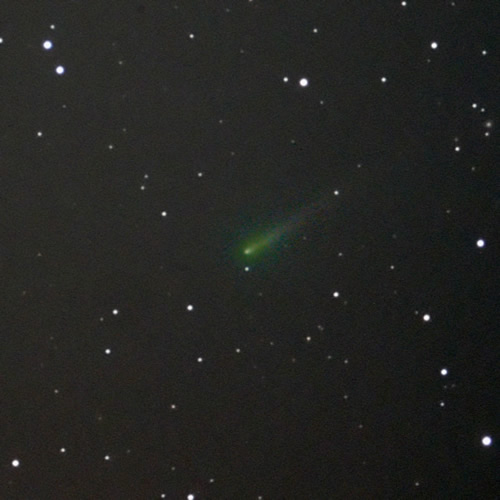
Comet ISON, imaged by Doug Hubbell on the morning of October 6, 2013 from Southern California. Hubbell used an Orion StarShoot Pro camera, Orion Atlas Mount, and Orion EON120 Telescope.
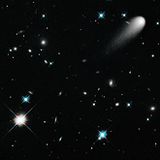
The Hubble Space Telescope imaged comet ISON on October 9, and NASA reported that the nucleus appears to still be fully intact.
"The comet's solid nucleus is unresolved because it is so small. If the nucleus broke apart then Hubble would have likely seen evidence for multiple fragments," says the Hubble Team. "Moreover, the coma or head surrounding the comet's nucleus is symmetric and smooth. This would probably not be the case if clusters of smaller fragments were flying along. A polar jet of dust first seen in Hubble images taken in April is no longer visible and may have turned off."
On October 26 comet ISON will be located within 3 degrees (RA 10 45 33.6 Dec +09 45 40) of the "Leo Trio" (M95, M96 & M105), presenting an excellent opportunity for astrophotographers to image. For even more clues to help you find the comet, on October 30 the Moon passes 6 degrees south of ISON. The comet is located at RA 11 02 43.9 - Dec +07 36 18 and should be very close to magnitude 8 - well within the reach of a small telescope.
November, 2013
As November opens, the race is on! Each night, comet ISON will be gaining in brightness; about two-tenths of a magnitude every 24 hours. It should have a visible coma and a concentrated, sharp nucleus, perhaps even beginning to show a tail!
On November 7 comet ISON passes less than a degree away from Beta Virginis. The comet will be located at RA 11 47 04.8 - Dec +01 46 57 and within reach of small optics at magnitude 7. It is heading towards the Sun and is accompanied in the morning sky by Jupiter and Mars. This comet is a sun-grazer and the closer it gets to our nearest star, the faster the gases and dust will begin to flow away. How much of a tail will it have by now? How big will the coma be? It's anyone's guess at this point in time, but predictions show it brightening between two and three tenths of a magnitude each night, and changing positions faster.
By mid-November, comet ISON will have rapidly moved towards the rising Sun and can be found buzzing through the constellation of Virgo. If predictions hold true, it should have reached at least magnitude 5 by this time and it is about to begin to blaze! Every 24 hours will see comet ISON gaining about 1/5 of a magnitude. Our "traveler" could be on the verge of becoming fantastic!
On November 14, comet ISON is located less than a degree away from 10th magnitude galaxy NGC 4697, making it an excellent target for astrophotographers.
It gets even easier to locate on November 18 as it passes less than half a degree away from bright star, Spica (Alpha Virginis). It will be located at RA 13 24 59.4 - Dec -10 48 47 and be just on the edge of unaided eye visibility at magnitude 5.
Be sure to set your alarm early for the morning of November 23 when you'll find comet ISON is located just slightly less than 5 degrees SSW of planets Mercury and Saturn. It will be located at RA 14 30 41.6 - Dec -17 38 00 and be faint, but visible to the unaided eye at magnitude 3.5.
The closer it gets to the Sun and its November 28 perihelion date, the more the tail will grow and the faster it will brighten. Just how fast will these changes occur? While we can't be entirely sure, it is predicted that ISON will jump several magnitudes in a period of three days - a jump which could possibly make it as bright as the planet Venus!
If comet ISON doesn't come apart, it should reach its maximum magnitude on November 29 and be located at RA 16 23 17.5 - Dec. -19 52 52. From this point forward, comet ISON will rapidly drop in brightness as its dusty "fuel" becomes exhausted. However, by no means is the show over.
December, 2013
The beginning days of December should still find it lighting up the skies at magnitude 1.0 and descending slowly - again just a few tenths of a magnitude every few nights.
By December 25, it should still be an unaided eye object at magnitude 4 and possibly remain as bright as magnitude 4.5 until the end of the year. Will comet C/2012 S1 ISON become one of the infamous "comets of the century"? Let's face it: we have no idea. Each and every comet has unique properties and ISON is no exception. There is just as much possibility that ISON could break apart and fizzle as there is for a spectacular performance. What we do know is that there is potential, and that's an exciting word for astronomers everywhere.
Have you imaged or viewed comet ISON yet? Let us know in the comments!
Tammy Plotner is a professional astronomy author, President Emeritus of Warren Rupp Observatory and retired Astronomical League Executive Secretary. She's received a vast number of astronomy achievement and observing awards, including the Great Lakes Astronomy Achievement Award, RG Wright Service Award and the first woman astronomer to achieve Comet Hunter's Gold Status.
|


{entityCount: 4}